
One of the most environmentally friendly alternative fuels is charcoal briquettes. These briquettes are a favourite of most people for cooking in stoves and boilers. Want to know about the briquette making process? Learn it here!
There are so many benefits and advantages that you can get from charcoal briquettes. And that’s the reason why so many domestic and industrial businesses do charcoal export.
What is briquette anyway? What kind of benefits does it have to become people’s favourite fuel? Then how is the briquette making process? Well, keep reading!
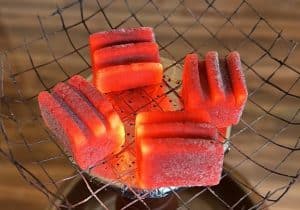
Briquettes or charcoal briquettes are solid fuels that can be used as alternative energy sources that have several shapes, such as tubes, blocks, and even irregular ones.
Generally, charcoal briquettes are found as cooking fuel. You must be familiar with the name charcoal barbeque when planning to hold a barbecue party.
Its versatility as a fuel also has many advantages over other alternative fuels. That’s why charcoal briquettes are widely preferred by many people.
Now it’s time to find out what advantages this fuel has that makes it favoured by a lot of people. Its advantages are :
1. High combustion value
2. Longer burning time
3. Delivers a stable and even burning process
4. Smokeless, spark-free, and tasteless
5. Lightweight
6. Easy to use
A charcoal briquette is mainly composed of two ingredients. The main one is the charcoal itself and some minor ingredients. Other minor ingredients are accelerants, white ash, and briquette binder.
The combination of the main and minor ingredients makes charcoal briquette have a lot of benefits and advantages. Let’s review the detailed components of briquette making.
Charcoal is the largest component, amounting for more than 70% in charcoal briquettes. Its function as a heat-producing fuel. The raw materials vary from coconut shell charcoal, beech, hard maple, and even oak.
In addition, there are also several other raw materials that make it easier for this charcoal to burn, such as mineral carbon, coal, and biomass..
During the combustion process, charcoal briquettes do not easily contact with oxygen. This is the reason an accelerant is needed to speed up the charcoal-burning process.
There are two accelerant options you can choose from, nitrate or sawdust. Nitrate is the most ideal choice as an accelerator. It was because it can accelerate combustion and provide heat at the same.
Unfortunately, nitrate is too expensive for some people. Therefore, sawdust can be another accelerator option with a price that is 10% – 20% cheaper. Sawdust can also provide effective combustion speed as well.
Next up is white ash. As one of the minor components of charcoal briquettes, white ash only accounts for 2% – 3% of all charcoal briquettes components.
Even so, the role of white ash is very important. With this material, the combustion process of charcoal briquettes will be longer due to the non-flammable nature of white ash.
Due to the lack of plasticity that causes charcoal briquettes not to stick together, a binder is needed. This is a mandatory ingredient that needs to be added to the process of making charcoal briquettes. The portion of briquette binder is around 5% – 7%.
There are many types of binders that are ideal for charcoal briquettes, such as starch, Arabic gum, and also paper pulp waste. For the cheapest option, you can choose paper pulp waste.
You also need to know how the briquette making process works. Well, there are several steps you can take to make charcoal briquettes.
The first step is to carbonize it for a week. You simply burn the raw material in a rotary cleaner with a stable temperature of 840 degrees to 950 degrees Fahrenheit.
After the carbonization process is complete, close the air inlet, then close the exhaust hole and let it cool down for two weeks. After 2 weeks, crush the raw materials that you have carbonized.
In the process of crushing carbonized raw materials, you can use tools such as hammer crushers or other types of crushers.
As a reminder, you should not crush these raw materials carelessly. Generally, the carbonized raw materials are crushed into pieces of about 5mm and below to aim high-quality charcoal.
Some of the crushed carbonized raw materials are still wet, hence the drying process is needed. You must ensure that the charcoal briquettes come with sufficient moisture content, not too low and not too high.
Why is that? Because unbalanced moisture content will cause the briquettes to be in low quality. If the water content is too high, then it can cause explosions. While if the water content is too low, then your charcoal will be difficult to mold.
Because of this, you must ensure that the moisture content of the charcoal briquettes is at the required level.
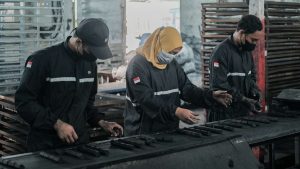
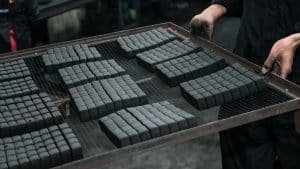
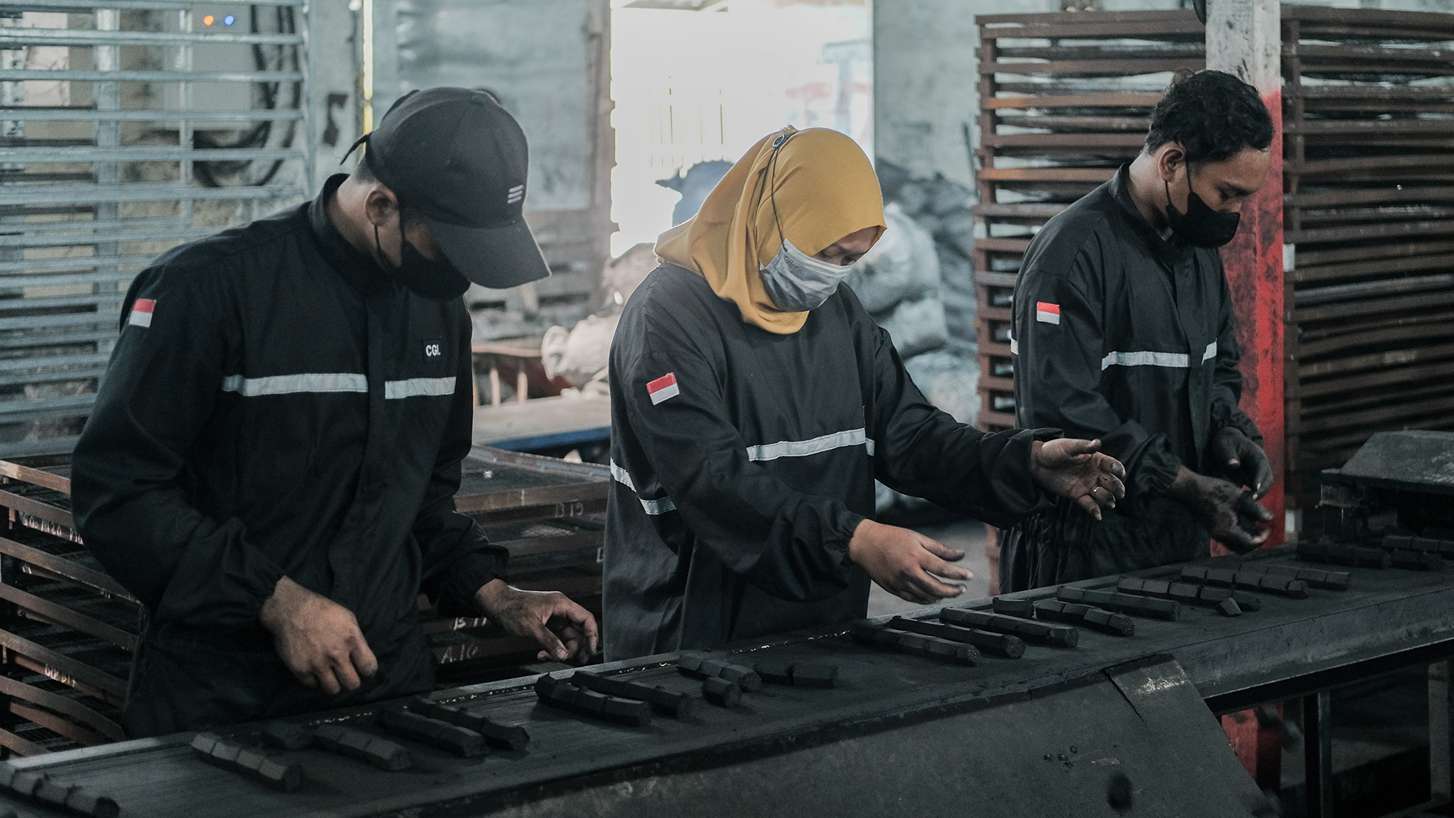
The next step is briquette making. This is the key step that determines the mold of the charcoal briquettes.
With the right amount of moisture, added binder, and a temperature of 105 degrees Fahrenheit, your charcoal briquettes will come with good quality and shape.
Once everything is done, the final process is to put the charcoal briquettes into the dryer and heat it at 275 degrees Fahrenheit. Yep, you have to redry your final briquettes.
When you’re done, you can start wrapping or storing them wherever you want.
From the explanations above, making charcoal briquettes is not a difficult thing. Nevertheless, you must have thoroughness in several things such as the ratio of components, humidity, and various other factors that can affect the results of your homemade briquette making.
Q : Are briquettes sustainable?
A : Yep, briquettes are a cheap, safer, and more sustainable alternative than other fuels.
Q : What materials are used to make briquettes?
A : Generally, there is a huge range of materials that you can use to make briquettes, such as charcoal dust, coconut shell charcoal, sawdust, and many other materials.
Q : How long do briquettes last?
A : In barbeque applications, briquettes generally last 4-5 hours.
Q : Can I make my own briquettes?
A : Yes, obviously you can. Everyone can make their own briquettes with simple waste materials.